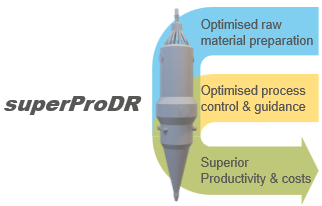
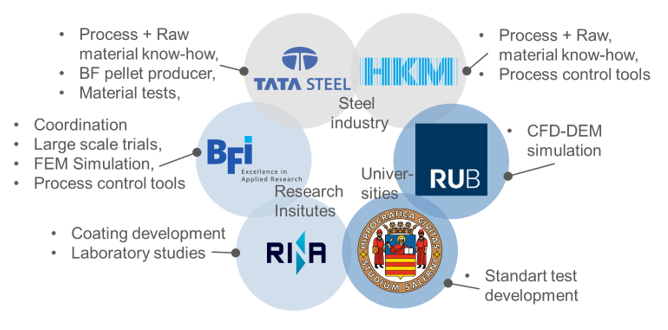
superProDR features an optimally balanced consortium covering all relevant competencies required to achieve the project objectives. The consortium combines universities providing state-of-the-art scientific knowledge on sticking mechanisms, research institutes experienced in transferring research results into industrial applications, and industrial partners ensuring relevance, feasibility and impact. Each partner contributes complementary expertise, enabling effective synergies across the consortium, as illustrated in the following figure and partner descriptions.
VDEh Betriebsforschungsinstitut GmbH (BFI) For BFI’s main tasks BFI owns workstations able to handle big data sets, holds software licences (e.g. MATLAB) and has already developed dedicated algorithms. For simulation, massive parallelised workstations and COMSOL software is available. General simulation models for the core of the CLH technology, the iron reduction and back oxidation are available. Needed software licences require only to be held in maintenance during the project duration, which requires approx. 20 % of the fees for new licences in the case of MATLAB. The tests with the pilot-plant will be executed at BFIs own testing facility at HKM steel work in Duisburg, Germany. The testing facility is equipped with a vast of analysers for measurement of e.g. gas flow, gas composition, temperature etc. and it is connected to the gas net of the steel work and thus, amongst others, BF gas and coke oven gas are available. For each task – project management, data analysis and simulation, pilot-scale trials, and holistic evaluation -the BFI employs specialised and very experienced (all > 10 years practise experience) and well-educated personnel (70 % of the staff are scientists and engineers, more than 50 % of the dedicated scientists hold a PhD). BFI also maintains a strong international industry and research network. Currently the institute has more than 50 running European and national-funded research projects which are complemented by approx. 90 privately funded projects in direct cooperation with the industry. Approximately half of the funded projects are coordinated by BFI. Scientific results are presented in around 100 publications per year.

Hüttenwerke Krupp Mannesmann (HKM) is an integrated steel manufacturer located in Duisburg, Germany and a subsidiary of thyssenkrupp Steel Europe AG, Salzgitter Mannesmann GmbH and Vallourec Tubes S.A.S.. HKM operates two blast furnaces with a total production capacity of 5 Mt/a and in total has around 3000 employees, which either work in the production or the administration. The technology department of HKM coordinates all research and development activities along the full value chain from raw materials to the products slabs and rounds. Technology is pushing HKM’s transformation project in all relevant fields including raw materials, direct reduction, electrical smelting and low-carbon energy matters. There are around 30 employees working in the department on different topics. With the injection of coke-oven-gas into the blast furnace started in 2023, HKM continues to gain experience with hydrogen reduction of iron ores at industrial scale. Up to today, an extra of more than 200 million Nm³ of hydrogen have been utilized this way. HKM (former ‘Mannesmann Röhrenwerke’) has a long tradition of RFCS and is involved in various funded projects regarding the transformation of steel production.
Tata Steel Nederland Technology (TSNT): The metallurgical laboratory at TSNT possesses state-of-the art equipment for evaluation of pellet quality. In the last several decades, R&D built strong expertise regarding pellet quality testing, as TSNT operates the only pelletizing plant in Europe which requires very strict pellet quality control. Other steel plants also operate similar (e.g. ISO) equipment, which is usually not used to specifically investigate sticking. Recently, TSNT has introduced high pressure thermogravimetric analyser (hpTGA), Gero furnace and DRI simulator (DRSim) to study HYL-process under different operation conditions. Both devices can be used to study sticking behaviour in 2-pellet scale as well as bed of pellets scale. The applicability of using those tests as predictors for sticking will be evaluated by the tasks below. Additionally, the fundamental relation between evolution of clusters and process/pellet/coating characteristics are investigated.

RINA-CSM (RINA) is a research company founded in 1963 by Italy’s major steel manufacturers and end-users for the development and application of innovative processes and materials and now part of Rina Group, a global provider of classification, certification, testing, inspection and training services for major industries. With a staff of about 230 researchers and technicians, 20 laboratories, pilot lines and full-scale testing facilities, it is the main reference for projects in which materials, technology and innovation play a critical role. The traditional presence of RINA-CSM as the Italian reference pole in European research (RFCS and Framework Programmes) results in hundreds of international collaboration agreements and contracts. RINA-CSM is a participant also in the European Technological Platforms like ESTEP (steel) and EuMat (advanced materials) and co-founder of RIES (Research Initiative European Steel). Currently RINA-CSM has more than 80 active Grant Agreements with the European Commission.

Ruhr-University Bochum (RUB) is one of Germany’s leading research universities. The University draws its strengths from both the diversity and the proximity of scientific and engineering disciplines on a single, coherent campus. RUB is the largest employer in Bochum (6.200) and one of the largest universities in Germany in terms of students (40.000). RUB has developed an in-house DEM-CFD code to simulate granular assemblies of thermally-thick particles, in which intra-particle reaction models (drying, calcination, direct reduction, pyrolysis) as well as contact models have been implemented. and it is perfectly suitable for the project.

The University of Salerno (UniSA) is participating involving two research groups of the Department of Industrial Engineering (nearly 100 permanent teaching staff, presently selected as Department of Excellence: one of the 3 of the 17 UniSA which gained this national recognition for the period 2023-2027). One of the two groups involved is the Particle Technology group (Poletto-Barletta), which is active in powder flow characterisation and handling. The group lab is equipped with commercial and locally developed instruments for characterising powder flow properties at ambient and high-temperature conditions, aside from the main basic powder characterisation methods such as particle size distribution, fluidisation properties and access to SEM analysis. In the project MaxH2DR, the group has developed the Hot Shear Testing Reactor which is able to carry out shear testing experiments on iron ore pellets during the reduction reaction. The reactor operates with a continuous gas flow, up to temperatures of 1000°C. The second is the group of heterogeneous catalysis (Palma-Vaiano). The heterogeneous catalysis lab is equipped to produce catalysts operating in harsh reactor environments, to fully characterise the physical and chemical catalysts structures, to carry out lab-scale and pilot-scale catalytic reactors controlling feed and operating conditions and by measuring product stream compositions and state variables. Both groups have strong international connections and have been involved in several EU projects.